August is dust in the wind and September has started with temperate weather. Tropical storm Hilary brought some rain and the red cape honeysuckle responded with red-orange blooms. This did not go unnoticed by the local hummingbirds and it quickly turned into territorial disputes between the little sprites. Recently, while watering the orchard, a little Anna’s hummingbird swept in to cool off in the hose-spray. It was in excess of one-hundred degrees so the little one needed some relief. I didn’t move the spray for over thirty seconds while it bathed and drank. What a rush. I take my phone with me now in case it happens again.
Static bird photography can be very boring, but with the golden hour back-lighting, I could not resist. One of my favorite botanicals, buckwheat is in its summer splendor right now as well.
August also brought some lovely butterflies. Swallowtail were abundant and the heat seemed to make them a bit slow (which was great). This “painted lady” species visited our flowers a couple of weeks back.
In Flight
Finally, the quail are still coming around! There are 3-4 coveys that pass through. We have put out water for them for the hottest days and they use it every day. These shots were made through kitchen window double pane glass so, they’re soft and green. First one shows a hen sharing water with her many chicks (some off to the sides on the ground). The second shows one of the chicks getting into the buckwheat.
And of course, the rest is history for the rest of us. The best laid plan is the one that gets done. The rest are foundations for wishful thinking. This entry actually starts with a hurricane. It ended for us as a tropical storm and brought a couple of inches of rain within a couple of days. Not too bad actually. Summer’s typical scorching heat was abated by about ten-to-fifteen degrees Fahrenheit. Very nice. The downpour was an early reminder that I needed to address a pooling issue at the rear of the house. There is one corner that gathers a confluence of flows from the hillside. It becomes overly saturated and the interior bathroom concrete will put off a water-saturated odor. It’s not offensive. You just know it needs fixing. So, I went to work. Digging. Why not, the soil was nice and wet, easy, right? Well, yes and no. It is evident that someone had attempted to address the issue previously. Much of the ground was removed, then mixed with 3/4″ crushed rock and then returned. This would allow water to flow into the soil below without too much pooling. It’s a good fix for 85% of So Cal “rains” which are light sprinkles. The fix is to create an underground gutter of rock with a 3″ perforated pipe to divert the water to a nearby drain already in place. The design is based on the classic “French” drain, but not as deep. It’s more of a swale. We did this at our other property with good success. After making a visit to our landscape irrigation supplier for materials, I headed off to a rock supplier and ordered two cubic yards to be delivered. They were great and delivered it within two hours after ordering it. The driver got it to the top of the driveway and we were off and running. Robin and I shoveled/wheelbarrowed the (approximately) five-thousand pounds of rock to the side of the house. By that time it was so hot, we were done for the day. “Hit it hard tomorrow” was the plan. That evening, I developed a scratchy throat and stuffy nose, but felt fine and slept well. I woke feeling tired and “spaced.” Not good. I knew right away what was happening but hoped it wasn’t true. Gathering up my tools, I went to work. I threw a digging bar for a few minutes then started to flat shovel the channel for the swale. Dizziness started to set in and a feeling of exhaustion. “I have to stop.” “What?” “I have to stop, I’m sick, no way, man!” The test confirmed. It’s C-19. That was four days ago. Now my poor Robin has it too. I’ve heard many compare it to a “bad cold.” (2) days fever, cough, congestion, brain inflammation, sneezing, severe tendon pain (work exasperated), complete exhaustion, headache, nausea, (3) days chills (sweater on at 75 degrees), the list goes on. Yup a bad cold. A real bad cold. Although, today feels like a breakthrough day. WOOHOO!
“Let’s rock.”
Tomorrow’s promise:
As for the hurricane, the day before its arrival, Robin woke me up and asked, “do you have cameras set up outside?” Occasionally I will make time lapse videos of stars and such and they put off a little light. She thought that was what she saw. “No,” was my it’s-five-in-the-morning-what-are-you-talking-about answer. “Look, you need to see this.” Oh… ok …what? So off in the distance, behind the mountains was a magnificent electrical storm. It lit up the night horizon wonderfully. It was too far off to hear any thunder. Still it was fantastic.
WOW!
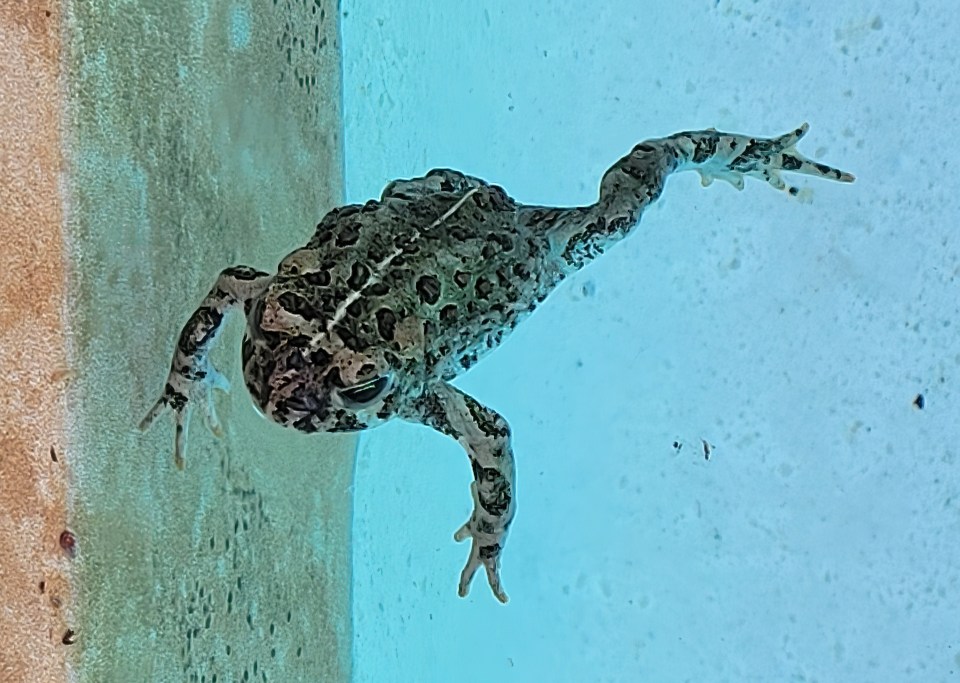
As for the opening image. Just more weirdness. This little toad insisted it was a frog and kept ending up in the pool. I kept removing it only to find it back in there. Last I looked, he was still gone. Crazy.
Lantana is not a banana Nor a canna But for this swallowtail Pure manna
After multiple years at Mission Trails attempting to nail a swallowtail in flight, I did manage a couple. MTRP boasts many of these butterflies, especially in August. Last year, we planted multiple plant types in one specific area to attempt to brighten it up. Mexican heather, lavender, *sweet pea, and two types of lantana (multi-color and yellow). We covered an area of about 100 square feet. Between the oppressive summer heat, rabbits and squirrels, 70% were consumed. The *butterfly bush and yellow lantana were the only survivors. The lantana works so well, we added two more. Luckily for us, hummingbirds and butterflies love the lantana flowers. One afternoon, I had some time to follow a swallowtail as it hopped from plant to plant.
DOF is at 1/2″ +-. The day was hot and some monsoon rain created a very muggy, slow feel to the day and it seemed to affect the swallowtail as well.
Here is one from the trails: Multiple exposures and some nuanced texture added in post.
Like clockwork our hills are spotted with buckwheat in transition. Some are red, some light peach, others are still white. The beauty of it is that honey bees feed from these plants. Sustained during the harsh summer heat. It’s connected, beautifully connected.






 Photographic Impressionistic Illusionistic